


The Real Competition Happens Before Patients Start Comparing Surgeons
Medical Tourism for Americans: How International Clinics Win Their Trust
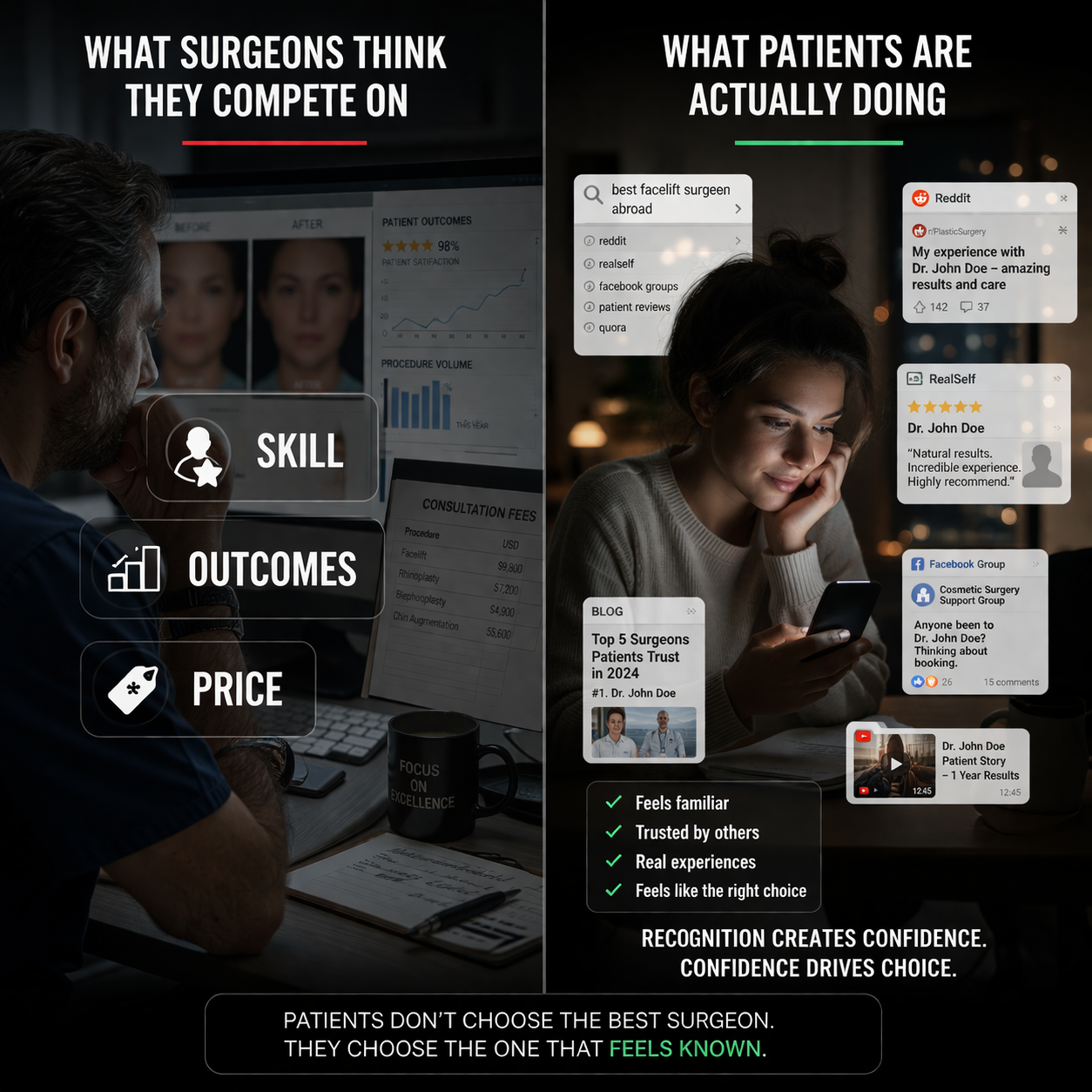
Most surgeons think they’re competing when patients start comparing options.
They’re not.
By that point, the decision is already leaning somewhere.
Patients don’t begin with comparison. They begin with impressions. Quiet ones. Passive ones. The kind they don’t even realize they’re forming.
And that’s where the real competition lives.
Patients Decide Earlier Than You Think
Long before a patient reaches out, they’ve already started forming a shortlist.
They’re not booking consultations yet. They’re not asking for quotes.
They’re simply noticing.
Who shows up.
Who feels familiar.
Who looks established.
That early exposure shapes everything that comes next.
By the time they start comparing, they’re not choosing from the entire market. They’re choosing from a pre-filtered list built weeks or months earlier.
If you’re not in that list, your credentials won’t save you.
Familiarity Wins. Even When It Shouldn’t.
People trust what they’ve seen before.
That’s it.
Not the best. Not the most qualified. The most familiar.
Psychology backs this. Repeated exposure builds comfort. Comfort reduces perceived risk. And in medical tourism, risk is the whole game.
If a surgeon’s name shows up across multiple places over time, it starts to feel known.
And known feels safe.
First Impressions Happen Fast
We’re talking milliseconds.
Patients don’t analyze first. They react first.
If your name or presence doesn’t immediately signal credibility, they move on.
And here’s the catch.
Those trust signals need to exist before they ever land on your website.
Because by the time they get there, they’re already deciding how they feel about you.
Why Self-Promotion Falls Flat
Patients are not naïve.
They know what’s controlled.
They know what’s promotional.
Your website? Controlled.
Your social media? Controlled.
Helpful, yes. But not convincing on their own.
What actually moves the needle is third-party presence.
Mentions. Features. Appearances in places you don’t control.
That’s where credibility transfers.
It feels earned. Not claimed.
Independent Signals Carry More Weight
When patients see your name in multiple, unrelated places, something shifts.
They stop questioning.
They start assuming.
It’s subtle, but powerful.
This isn’t about flooding the internet. It’s about showing up in the right environments repeatedly.
Consistency across independent sources builds a pattern.
And patterns build trust.
What This Looks Like in Practice
This isn’t random visibility.
It’s structured.
It starts with identifying where patients form opinions before they compare.
Then placing your expertise into those environments in a way that feels natural.
No hard selling. No noise.
Just presence.
Over time, those signals stack.
And when they stack, something interesting happens.
You stop being “one of many.”
You become the one they already recognize.
What Changes When You Get This Right
Everything speeds up.
Patients don’t come in cold.
They come in leaning yes.
You spend less time convincing.
More time confirming.
Inquiries get sharper.
Decisions get faster.
And resistance drops.
Because they’re not deciding if they trust you.
They’re confirming that they already do.
The Shift Most Surgeons Miss
Most surgeons focus on being found.
That’s the wrong target.
Being found means you’re entering the race late.
Being recognized means you were never really competing.
That’s the difference.
Final Thought
Being seen isn’t the goal.
Being selected is.
And selection doesn’t happen when patients start comparing.
It happens before that.
Quietly. Repeatedly. Predictably.
The surgeons who understand this don’t chase attention.
They build familiarity.
And when the moment comes to choose, their name already feels like the obvious one.